How to Make Your Brand Memorable
How to Make Your Brand Memorable
There's a reason some brands stick in the back of your head and others don't.
You could name one right now. Maybe it was the orange packaging, or the guy who answers his own phone every time you call, or a newsletter so well designed you'd know it was theirs with the name taken off.
Some brands you run into one time and they lodge. Others you see fifteen times and you still couldn't say what they do or who they do it for.
The difference is whether there's anything specific to grab onto. So when people ask me how to make your brand memorable, I tell them the material is almost always already sitting in their business, waiting to be used on purpose.
What makes a brand memorable
It takes two things to be memorable. You need something distinctive, and it needs to show up consistently enough that it lands in people's heads.
Distinctive means specific enough that it points at you and only you. Consistent means it appears often enough that people connect it to you without having to work at it.
I've spent 25 years watching brands try to get memorable, and the ones that manage it almost always got there by repeating one small thing for a very long time.
The research agrees, which is always nice. Ipsos and JKR tested more than 5,000 brand assets with over 26,000 people and graded each one on whether it brought the brand to mind with the name stripped off, and 15% managed it.
What separated the winners was sustained use rather than better design, according to their findings.
That's very good news for a solopreneur with no design team, because consistency costs nothing and you can start on Tuesday.
Why do people forget a brand they liked?
Usually because there was nothing specific in it to hold onto.
The offer gets described the way everyone else in the category describes it. The process is really good and it's called onboarding. The content is smart and it looks like every other smart post in the feed.
Someone walks away with a warm feeling and nothing they could repeat out loud, and warm feelings fade by Thursday
The three sizes of a memorable brand
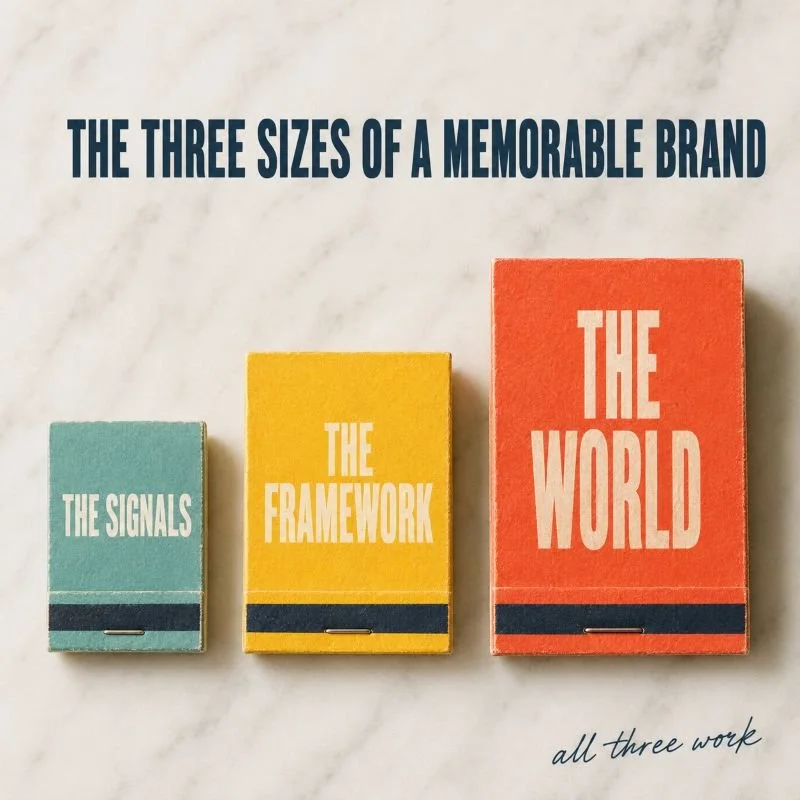
The thing that makes you memorable can be enormous or it can be tiny, and both sizes work. Most people assume they need the enormous version, which is exactly why so many of them never start.
The world
The biggest version is an entire world your brand lives inside. Mine is a bar, and that was a deliberate decision I made before I had a single client.
One of the jobs your brand has is making sure people remember you, so I built mine to do that job on purpose. I wanted something unmistakably me that would make me the obvious choice in the room.
The bar works because I think in cocktail metaphors. It handed me an endless supply of names, illustrations, and language for my frameworks and my products, and I still haven't hit the bottom of it.
Members get a monthly pour. There are garnishes to mix in, a happy hour at the end of every recipe, and a live session called Mix It Together, and I have never once had to explain the metaphor to anybody.
Building a whole world was my move. Plenty of my clients want nothing to do with a theme, and we get them just as memorable by pulling out what's already distinctive about them and putting it everywhere.
The framework
The middle version is a named method, offer, or process. Mine is the Signature Brand, built on three pillars: Credibility, Personality, and Expression.
Giving your method a name turns a service into a system. It hands other people something to point at, which is how anybody learns to associate an idea with you.
Most businesses already run the same process for every single client and have never put a name on it. That makes this the fastest upgrade available to almost everyone reading this, and it costs you one good afternoon.
The signals
The smallest version is the little stuff you repeat everywhere. My bullets are always an orange diamond, I talk about brands staying at proof, and there's usually a cocktail somewhere in the photo.
Every one of those started as a small choice I liked and kept making until other people began noticing.
Signals are where you start when the bigger two sizes feel like a project, and they build the same recognition over time, one repetition at a time.
What counts as a thing that sticks
Plenty of things can become the thing people remember, as long as you can own it and repeat it:
🔸 A named framework, offer, or process
🔸 A word or phrase you reach for constantly
🔸 A recurring format people learn to expect, like the Friday email or the monthly reset
🔸 A color, shape, or object that shows up in everything you make
🔸 A ritual, meaning the way you always open or the way you always close
🔸 A tagline, when you're using it everywhere
Whatever you land on, it should be present the very first time somebody encounters your brand. That could be an emoji at the top of a caption, the name of your framework, the way your key messaging sounds, or your look and feel.
Every business lands somewhere different. The businesses that stick have something that sticks.
How to make your brand memorable in three steps
Do these in order. All three fit inside one working afternoon.

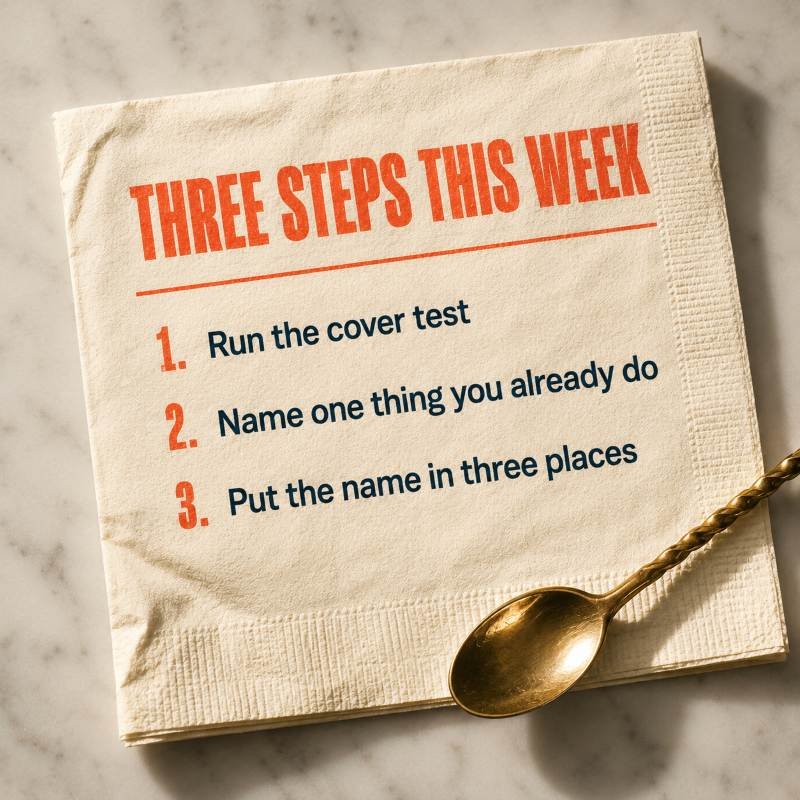
Step 1: Run the cover test
Take your name and your logo off your homepage and read the page like a stranger who has never heard of you.
Whatever still reads as unmistakably yours is what you already have working, and it's usually one or two things. If the page could belong to anyone in your industry, you just found your starting point, and you found it in about four minutes.
Step 2: Name one thing you already do
Pick the process, the format, or the ritual that runs the same way every time you do it.
Give it a real name, something you'd say out loud on a client call without wincing. If your five step process calls them step one and step two, your client remembers a number, and if those same five steps have real names, your client has five things to say about you to somebody else.
Your clients may have already done this for you. If people have nicknamed something you do, use their word for it.
Step 3: Put the name in three places
A name that only exists on your sales page is doing a fraction of its job.
Put it in a caption, an email subject line, and your bio this week. Three placements will do more for you than a perfect name sitting in one spot for a year.
How long before people actually remember it?
Longer than feels reasonable, and the timing is going to mess with you.
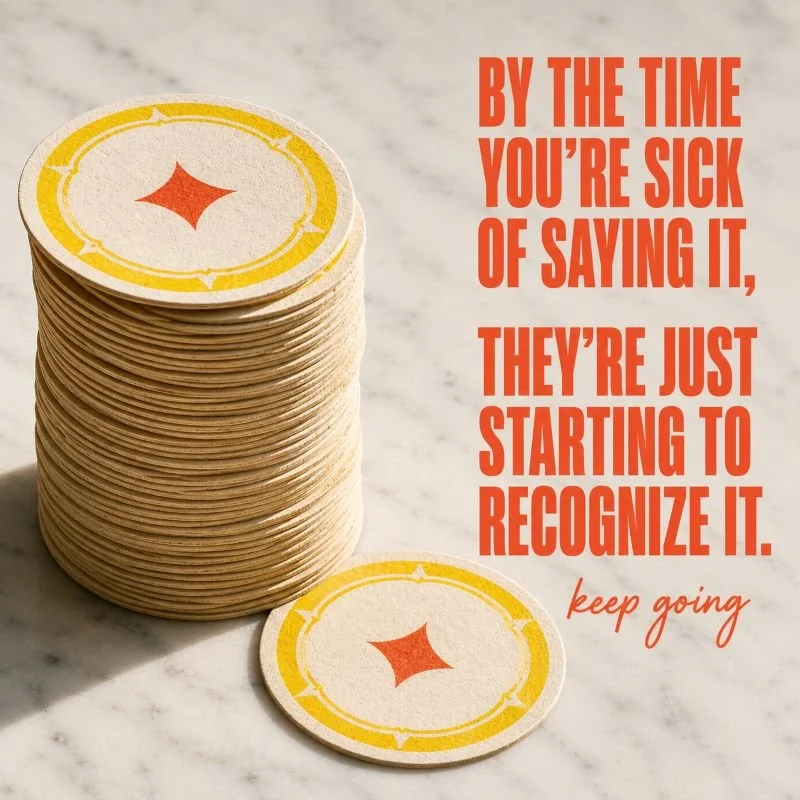
By the time you are thoroughly sick of saying your phrase, your audience is just starting to recognize it. You live with your brand every single day, and they catch it in fragments, somewhere between the school pickup and somebody else's ad.
That gap is where good branding gets abandoned. Boredom with your own material shows up months before recognition does, and it feels like proof you picked the wrong thing.
The move is to keep going anyway. Being distinctive and owning it is what puts you ahead of the game, and the brands you admire got there by staying with something long past the point where it still interested them.
Pick your one thing this week, name it, and repeat it until it's familiar.
Can you tell whether your thing is landing?
From inside your own business, it's hard. You've read your own homepage so many times that your thing feels obvious to you, and the way to know is to look at everything you published this month and count.
That's The Brand Bar. Every month I read everything you publish across your website, your emails, and your social channels, measure it against your Signature Line, and hand you back one move to make. September's focus is what your brand owns.
It's $497 for the year as a house account, and you can pull up a seat here.
Keep Reading
🔸 You're Not as Consistent as You Think: Memorable brands repeat themselves everywhere, so check whether yours shows up the same way on every platform.
🔸 Can Someone Actually Describe What You Do?: Being remembered starts with being easy to describe, and this post covers what makes a brand message clear.
🔸 What Makes a Brand Work: The 3 Pillars Every Signature Brand Is Built On: See how memorability fits into the bigger picture of credibility, personality, and expression.