Your Brand Values Are Already Showing. Here’s What They’re Saying.
Walk into any bar worth its salt and you'll find the house rules posted somewhere. Maybe above the register. Maybe framed by the door. Sometimes scrawled on a chalkboard behind the bar. They tell you immediately what kind of place this is, what gets you a second round and what gets you cut off. You don't have to ask. You don't have to wait and see. The rules are right there.
The best brands work the same way.
Your values aren't something people should have to read about. They're something people should be able to watch. In how you show up. How you handle a hard conversation. How you price your work. What you decline without apology. The experience someone has with you from the first inquiry to the final delivery.
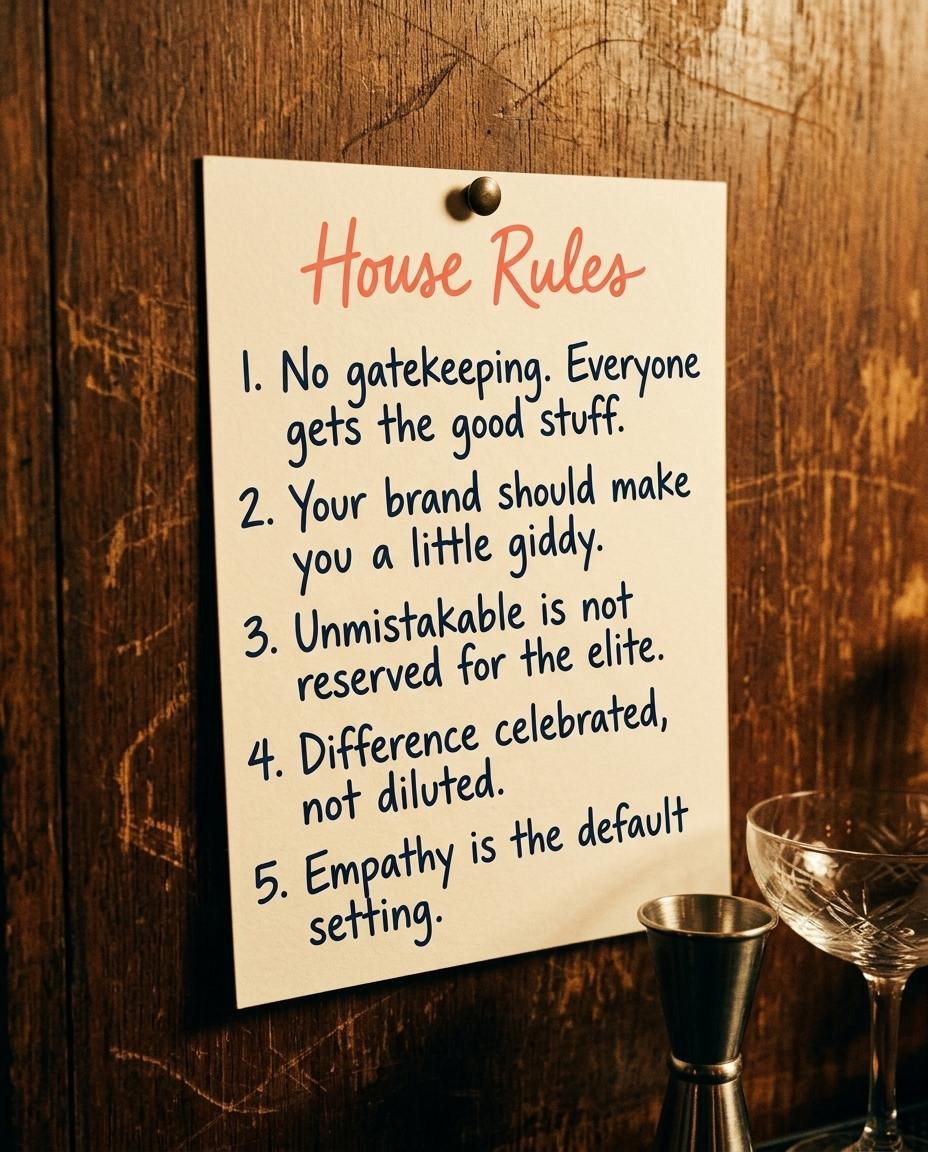
At District Brand Bar, the house rules aren't just buried on an About page. They show up in every piece of content, every offer, every client interaction:
🔸 No gatekeeping. No flavorless brands.
🔸 No standard menu passed off as strategy.
🔸 Empathy as the default. Difference celebrated, not diluted.
Those aren't aspirations. They're operating standards. And whether you're reading a blog post, inside a Brand Bar recipe, or working together 1:1, you feel them before anyone has to explain them.
That's the version of brand values that builds credibility. The pattern someone notices while you're working.
Most solopreneurs have done the values exercise. They picked three to five words that felt true (integrity, authenticity, excellence), put them on their About page, and moved on. The values are listed. So why aren't they landing?
Because listed values and visible values are two completely different things. And closing that gap is one of the highest-leverage moves you can make for your brand right now.
The Problem With Values as a Checkbox
The standard brand values exercise asks you to pick words that represent what you believe. That's not wrong. But it's incomplete.
The words you choose matter far less than whether someone can see them in action.
What "No Gatekeeping" Actually Looks Like
Take "no gatekeeping" as a value. Any brand could write that on its website. But you know what it actually looks like? It looks like giving people the strategy behind the strategy, not just the surface-level advice. It looks like building an ecosystem where someone can access real thinking at every price point. It looks like never making someone feel like the good stuff is being held just out of reach.
That's a value made visible. And the difference between a brand that lists "no gatekeeping" and one that actually lives it is something your ideal client feels before they ever read your values statement.
Stated vs. Demonstrated: A Real Example
Two brands both list "we lead with empathy" in their values.
Brand A: Has it on their About page, italicized and centered. That's the last you see of it.
Brand B: Writes onboarding emails that anticipate every question a nervous new client might have before they think to ask. Checks in mid-project without being prompted. When something goes sideways, addresses it directly and calmly instead of going quiet.
Same stated value. Completely different demonstrated one. Your clients can feel the difference. They just can't always name it.
According to the 2024 Edelman Trust Barometer, 55% of consumers are likely to remain loyal to a brand they trust, and 53% said they would recommend it to others. Trust isn't built by telling people what you stand for. It's built by showing them, consistently, over time.
What Do Brand Values Actually Look Like in a Brand?
If you want your values to live outside of a list, they need to show up everywhere your brand makes a decision.
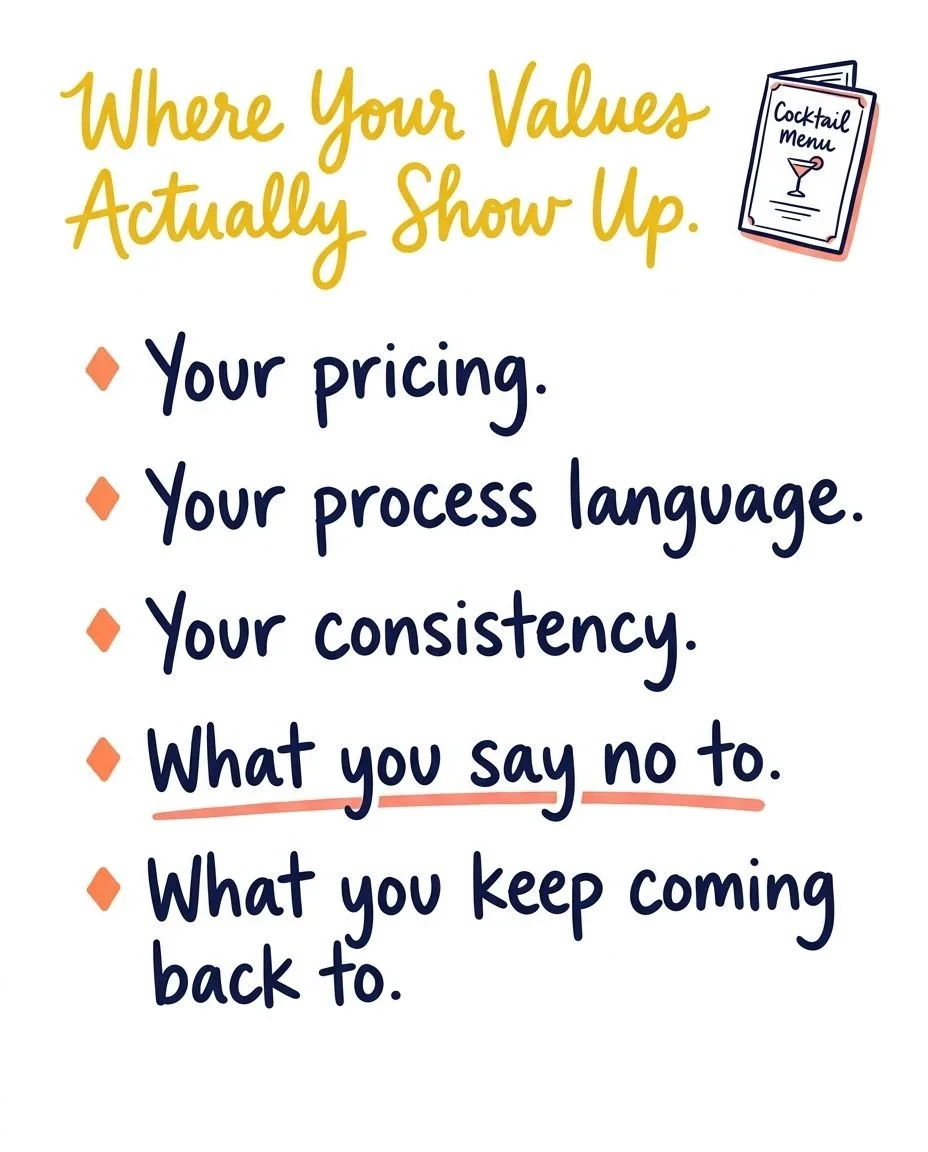
Your Pricing
What you charge, what's included, what isn't, and how you talk about the investment. Pricing is one of the most honest reflections of a brand's values because it's where conviction meets reality. A brand that genuinely believes "unmistakable isn't reserved for the elite" builds that belief into its structure. The entry points exist. The access is real. The price reflects the philosophy.
Your Process Language
A brand that values depth and intentionality doesn't describe its work the same way a brand that values speed and efficiency does. The language is different. The promises are different. The experience being offered is different. Someone reading your process description should be able to sense what you prioritize before they ever see a testimonial.
Your Consistency
Think of it like a well-built cocktail menu: every drink is different, but the hand behind them is unmistakable. A brand that values clarity looks clear everywhere — on the homepage, in the emails, in how offers are explained. When the voice, the standards, and the experience hold across every place your brand lives, people trust what they're seeing. That coherence is what makes someone come back.
What You Say No To
The clients you don't take. The partnerships that don't feel right. The corners you won't cut even when it would be easier. Every boundary you hold is a value in action, whether you've ever written it down or not.
How Do You Know If Your Brand Values Are Working?
The 10-Minute Test
Could someone who has spent 10 minutes with your brand name at least one thing you stand for, without ever reading a values statement?
🔸 If the answer is yes, your values are working.
🔸 If they'd have to dig — scroll to your About page, read your entire bio, or already know you personally — there's a gap worth closing.
Research from Salesforce's State of the Connected Customer report shows that 52% of global shoppers are more likely to purchase from a company with shared values. But shared values only create that pull when they're actually visible. A prospective client can't connect with values they can't find.
The Referral Test
Ask yourself what your clients say about you when they refer you to someone else. How do they describe the experience?
Those words — the ones that show up unprompted, in someone else's language — are your demonstrated values. And they're almost always more accurate than anything you've written on your About page.
Where Do Brand Values Show Up Besides Your About Page?
Five places worth checking right now:
🔸 Your process language. Does it reflect what you genuinely value about the work, or does it read like a generic service description that could belong to anyone in your space? If you stripped your name off it, would it still sound like you?
🔸 Your offer descriptions. Specificity is a values signal. Vagueness is too. What your offers promise — and what they don't — says something about your standards whether you intend it to or not.
🔸 Your client-facing communication. How you write your emails, how you handle questions, how you show up when something gets complicated. Empathy as a default setting looks different from professionalism as a default setting. Your clients feel that distinction even when they can't name it.
🔸 Your consistency across platforms. Does your LinkedIn feel like the same brand as your Instagram? Does your homepage match the energy of your emails? A brand that holds the same tone, standards, and experience everywhere isn't just consistent. It's trustworthy.
🔸 What you keep coming back to. The beliefs and ideas you return to across different formats and contexts — those are your values in disguise. If you keep saying the same thing in ten different ways, that's not repetition. That's your brand telling you what it actually stands for. Listen to it.
The Difference Between Stated and Demonstrated Brand Values
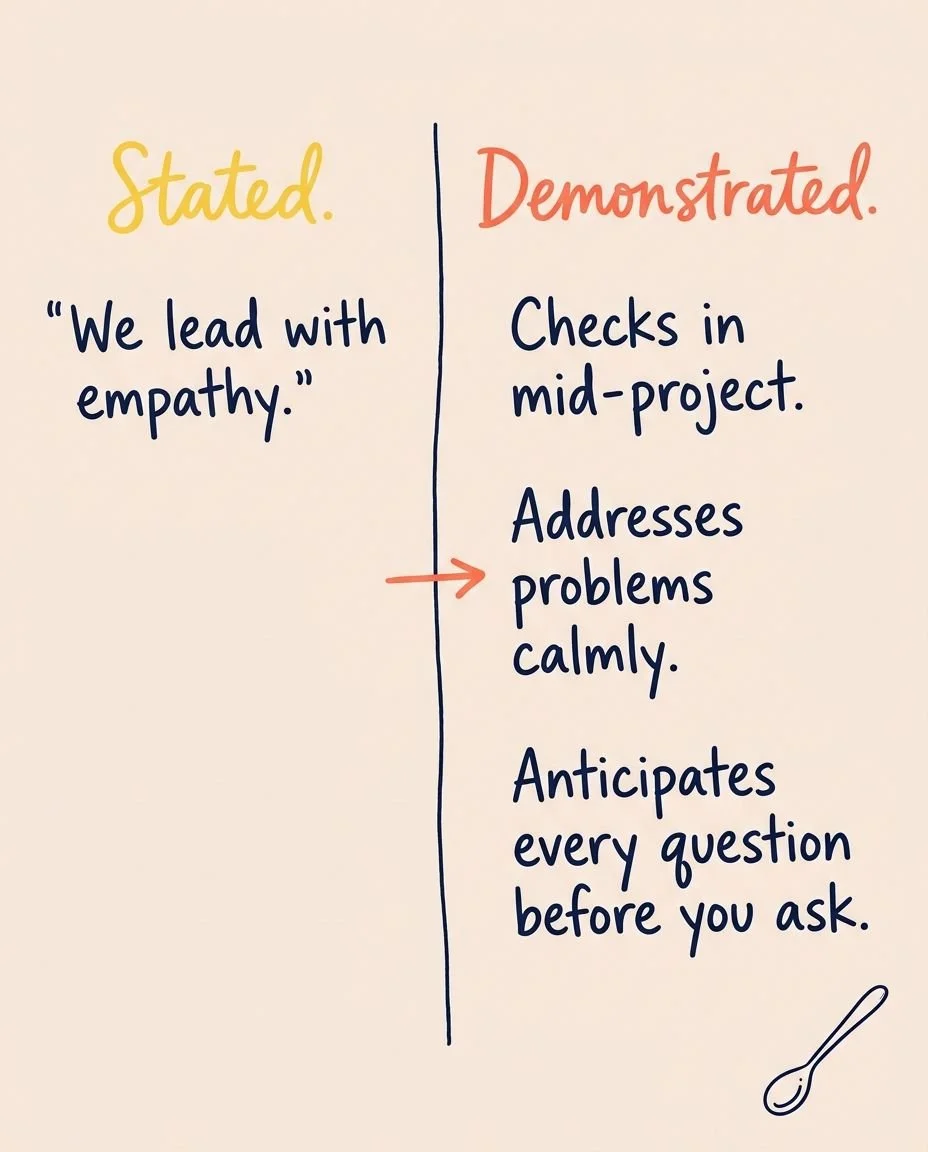
Stated values are the ones on your website.
Demonstrated values are the ones your clients mention when they refer you to someone else.
The goal is to close the gap between those two things. Look honestly at whether the pattern of your brand reflects what you actually believe about your work and the people you serve. That's the work.
Your brand should make someone feel something before they get on a call with you. The kind that comes from being consistently, visibly yourself across every place your brand lives. That's what empathy as a default setting actually looks like in a brand. A pattern someone feels long before they read a single line about it.
When your values are embedded that way — in the decisions, the language, the experience, the things you won't compromise on — something clicks for the right person encountering you for the first time. They don't just understand what you do. They trust you before they've paid you a dime.
That's the credibility a values list can't create on its own.
Start Here
Pick one value you hold strongly in how you work. A behavior you do consistently, something clients have mentioned, something you'd never compromise on even when it would be easier.
Then look at your brand and ask:
🔸 Is it visible on your homepage?
🔸 Does it show up in your offer descriptions?
🔸 Is it reflected in the way you talk about your process?
If it's present, good. Notice where it's strongest and let that lead.
If it's thin, that's the gap worth closing first. Start with more consistency in the places where your brand already lives.
Your values are already showing. The question is whether they're saying what you mean.
Inside The Brand Bar, every month is a chance to look at what your brand is actually communicating — and make sure it matches what you stand for. If you're ready to stop guessing and start refining, pull up a seat.
Keep Reading
🔸 How to Build Trust With Your Brand at First Sight: Trust starts before anyone reads your About page, and this post covers the signals people pick up on first.
🔸 Brand Chemistry: Why the Right Clients Just "Get" You: The clients who share your values are the ones who click with you, and this post is about attracting more of them.
🔸 What Makes a Brand Work: The 3 Pillars Every Signature Brand Is Built On: Your pricing and process belong to credibility, one of the pillars every signature brand is built on.