What Is a Strong Brand (and Why So Many Still Get Overlooked)
And three simple steps to turn your strong brand into a signature brand.
A strong brand does its job well. It’s recognizable, consistent, and credible across platforms. When someone encounters it, they understand what the business does and feel confident it’s legitimate.
And yet, many strong brands still struggle to stand out.
That isn’t a reflection of effort or intelligence. It reflects how crowded the landscape has become. In a recent survey, 31% of marketers named brand differentiation as their biggest challenge, which signals a shift in how recognition works. Awareness alone no longer creates preference, and familiarity does not automatically lead to loyalty.
This is where the distinction between a strong brand and a signature brand starts to matter.
A strong brand gets you in the room. A signature brand gets remembered once you’re there.
That distinction changes how brands are built, maintained, and experienced.
What a Strong Brand Actually Is
A strong brand is built on clarity and consistency. Research consistently shows that businesses presenting themselves coherently across channels see measurable gains, including 10–20% increases in revenue growth tied directly to consistent brand presentation. Visual cohesion alone can have a powerful impact. Studies have shown that using a single, consistent color can increase brand recognition by as much as 80%.
This is the baseline and the foundation.
A strong brand looks professional, feels trustworthy, and communicates competence quickly. It reduces friction for a new audience and delivers exactly what it promises to deliver.
In mixology terms, think of a strong drink.
I can make you a drink that’s strong in a lot of ways. I can pour heavy. I can use cheaper rail liquor. I can mix something simple that gets the job done fast. A rum and coke can be strong if you’re a lightweight. It will still deliver on the promise of being strong.
I can also make you a strong drink with top-shelf ingredients. A gin martini. A nice pour of a really good whiskey. They are higher in quality, have a cleaner finish, a higher price point, and they definetly delivers on strength.
In both cases, the drink does what it says it will do.
That’s what a strong brand does. It works. It functions. It meets expectations.
The open question is not whether it’s strong. The question is whether anyone remembers which one they had.
Why “Strong” Often Stops Working on Its Own
When I’m just ordering something because it’s strong, I’m not paying attention. I’m not thinking about what’s in the glass or whether I’d order it again. I’m just drinking to drink that night.
It does the job, and then it disappears.
That’s what happens with a lot of strong brands. They follow all the right best practices for clarity and polish, so they function well, but they don’t leave much of an impression. You recognize them in the moment, yet struggle to remember what made them different once you move on.
When many businesses aim for the same definition of “professional,” the result is competence without contrast. Everything looks good. Everything makes sense. Very little stands out.
Brand research reflects this pattern clearly. Studies on perceived differentiation show that brands offering something distinct outperform others on customer satisfaction, loyalty, market penetration, and perceived quality, even when the underlying products or services are functionally similar.
This is the ceiling many strong brands hit. They communicate well, they check the boxes, and they still feel interchangeable. They get consumed, not remembered.
That’s the point where strength alone stops being the differentiator.
What Makes a Brand “Signature”
A signature brand carries everything a strong brand does, plus identity. It isn’t only recognizable. It’s recognizable for something specific.
A signature brand reflects preferences, taste, point of view, and choice. It feels like it came from a person, not a checklist. It leaves a residue after the interaction ends.
Research on brand authenticity explains why this works. When a brand feels aligned with identity and values, trust increases. That trust drives loyalty. People don’t just recognize the brand. They rely on it.
A signature brand doesn’t simply look consistent. It feels intentional.
Back at the bar, this is the difference between a drink that does the job and one you remember ordering again.
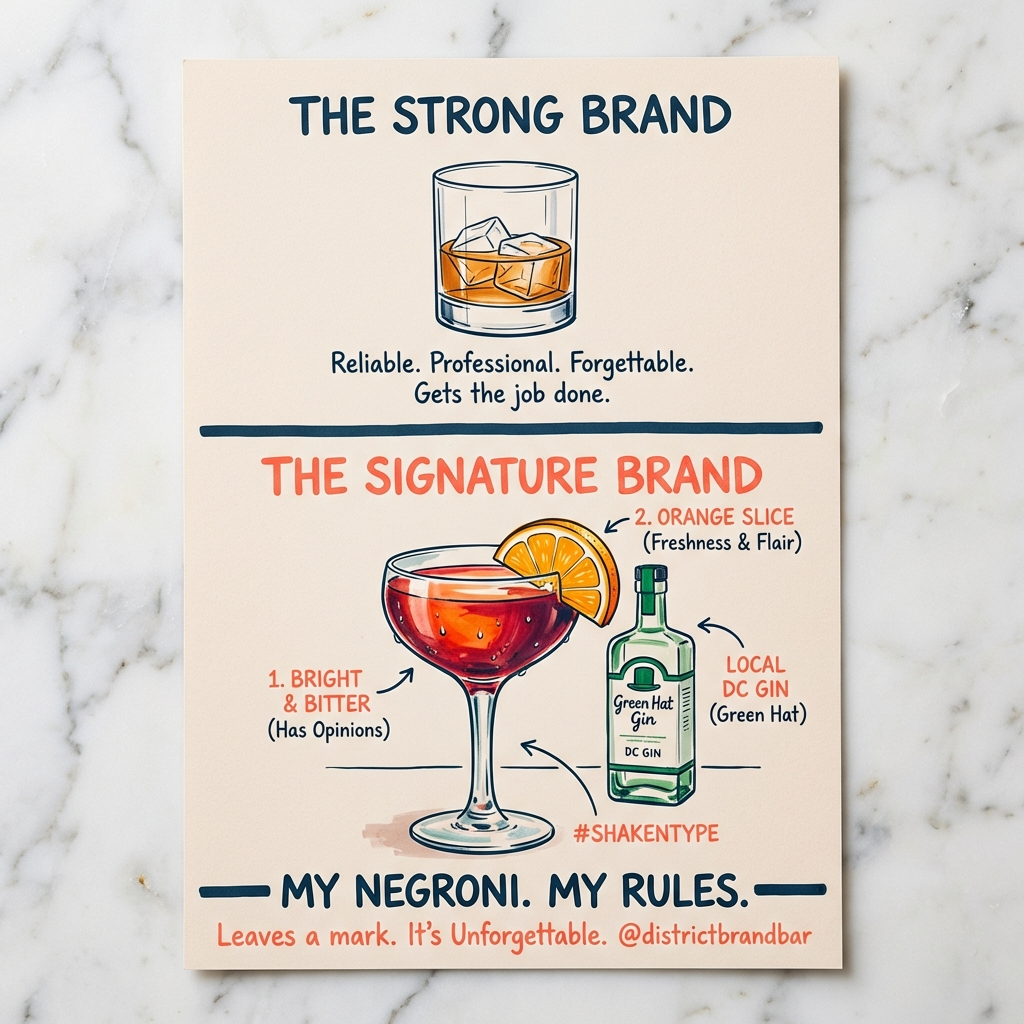
For me, my signature brand cocktail is a Negroni.
It’s bright. Colorful. Bitter. It has opinions.
I’m not reinventing the cocktail. I’m starting with something people already know. Then I make it mine. I’d use a DC-based gin like Green Hat Gin because local flavor matters to me. I’d shake it, not stir it, to wake the drink up and get it ice cold. That choice alone says something about how I move. I’m a shaken type. Anyone who’s taken my quiz knows that.
I’d serve it with an orange slice, not just a peel, because I care about freshness and experience, not just tradition for tradition’s sake.
I started with an already fantastic cocktail and then made it mine.
Strong Brand vs Signature Brand. What Actually Makes the Difference
This shift isn’t about moving from bad to good. It’s about moving from functional to memorable.
The difference between a strong brand and a signature brand comes down to memorability, identity, and emotional alignment.
A strong brand builds recognition through clarity and consistency. It establishes credibility and reduces friction. It does what it’s supposed to do.
A signature brand adds differentiation, emotional alignment, and a point of view people can feel. It gives the audience something to associate with you specifically, not just the category you’re in.
Data consistently shows that brands perceived as differentiated outperform even highly visible ones. They earn loyalty, preference, and trust because they stand for something clear and believable.
A strong brand gets consumed. A signature brand gets chosen again.
Three Things I’d Do Today to Move from Strong to Signature
If your brand already feels solid but forgettable, this is where I’d start.
1️⃣ Add a Signature Detail to Your Email Sender Name
Your email sender name is one of the most overlooked brand touchpoints, and it shows up constantly. Instead of using only your first and last name, add a signature detail people can immediately associate with you.
That might be a title, a phrase, or even an emoji. I use a 🥃 after my name because it visually reinforces the mixology theme and signals what my brand is about before someone even opens the email.
It’s a small change, but recognition compounds fast.
2️⃣ Choose One Signature Line and Repeat It Everywhere
Pick one line that captures how you talk about your work, then use it consistently across your bio, website, emails, and content.
For example, I don’t say “I build brands.” I say, “I craft signature brands.” That word choice reinforces intention, artistry, and process in a way that feels aligned with my brand.
If someone could screenshot one sentence and immediately know it came from you, you’re doing this right.
3️⃣ Remove One Neutral Phrase This Week
Neutral language is often the last thing standing between a strong brand and a signature one. Scan your website or recent content and remove one “safe” phrase that you see many other businesses use in their copy.
Replace it with something more specific, more human, and closer to how you’d actually say it to a friend over brunch. That’s where personality shows up, and that’s where memory forms.
Why a Signature Brand Matters More Than Ever
For solopreneurs and small business owners, a signature brand carries real leverage. It does more of the marketing work for you, which changes how everything else feels. Content takes less effort to create. Messaging becomes easier to repeat. Visibility builds on itself instead of starting over each time you show up.
That’s why so many founders eventually step away from constant rebrands and one-off fixes. What they actually need is a way to keep their brand clear, aligned, and intentional as the business grows.
That’s the role The Brand Bar plays.

The Brand Bar is a brand maintenance system designed to help you keep your brand sharp over time. It gives you a structured way to revisit your positioning, language, and signals regularly, so your brand doesn’t drift as your offers evolve or your visibility expands. Instead of tearing things down and rebuilding, you refine what’s already working and strengthen what makes you recognizable.
This isn’t about chasing trends or reinventing yourself every quarter. It’s about staying unmistakably you as your business changes.
If your brand already feels strong, The Brand Bar is how you make sure it stays intentional, distinctive, and easy to recognize wherever people encounter it.
🍾That’s how strong brands become signature ones.
Keep Reading
🔸 What Makes a Brand Work: The 3 Pillars Every Signature Brand Is Built On: Go deeper on the pillars that turn a strong brand into a signature one.
🔸 How to Make Your Brand Memorable: Once you know what makes a brand signature, this is how you make it stick in someone's memory.
🔸 Your Brand Uniqueness Is Already There. You Just Keep Editing It Out.: The distinct part of your brand is probably already there, and this post shows where you've been editing it out.