Your Brand Uniqueness Is Already There. You Just Keep Editing It Out.
There's a moment in every business owner's life when their brand starts sounding a lot like everyone else's. You pick up a phrase from a peer. You borrow a framework from a workshop. You adopt the words your clients use to describe you, and little by little, the writing starts blending into the wallpaper of your own industry.
The thing is, it didn't happen because you stopped caring about brand uniqueness. It happened because you got better.
You refined your process. You learned the professional language. You studied what "good" looks like in your space. And somewhere in all that growth, the stuff that made you sound like you got quietly replaced by the stuff that made you sound competent. Polished. Safe.
And polished and safe are fine qualities in a lot of contexts. They just don't make anyone remember you.
The Polish Problem With Your Brand Personality
Most business owners I work with don't have a branding problem. They have a polish problem. Their websites are clean. Their copy is professional. Their Instagram bios check every box. And if you swapped their name out and dropped in a competitor's, most people wouldn't notice.
That's the real cost of over-polishing. You stop sounding like a specific person and start sounding like a category. A "brand strategist." A "health coach." A "business consultant." The words are all competent, and none of them carry a fingerprint.
Research backs this up. Emotional content performs 2x better than rational content, and 82% of emotionally bonded customers stay loyal through competitive pressure and market changes. The professional, sanitized version of your brand may look right, but it's the personal, specific, slightly imperfect version that actually builds connection.
Your audience can feel the difference. 86% of consumers say authenticity matters when choosing which brands to support, and 60% prefer content that feels authentic over content that feels polished or perfect. Read that again: most people actively prefer the less polished version.
Where Brand Uniqueness Actually Lives
Brand uniqueness sounds like a big, abstract concept. It's really a collection of small, specific details.
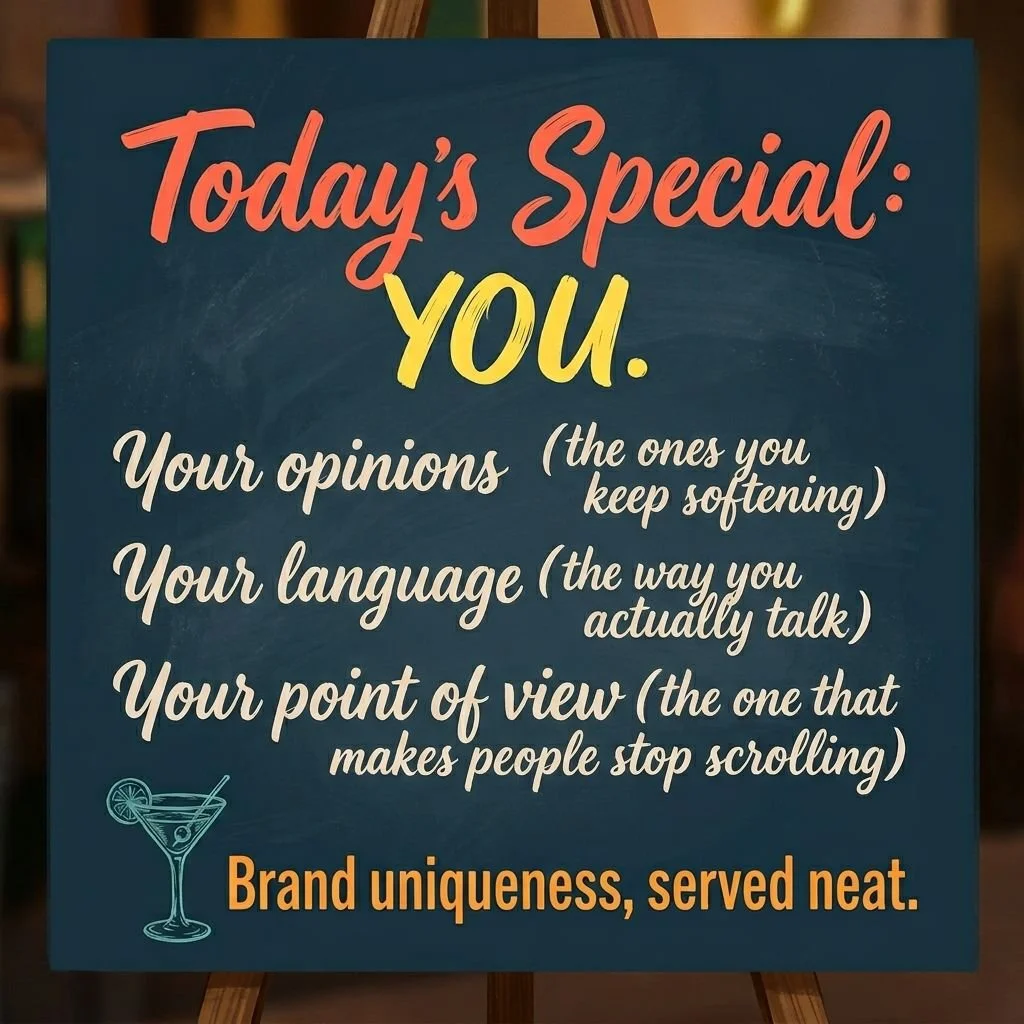
It lives in the opinions you hold that others in your space would sand down or avoid. The language you use when you're explaining something to a friend, not performing expertise. The references and metaphors that show how your brain actually works. The rituals and patterns that shape how you work. The stories you come back to again and again because they taught you something real.
These are the things that belong to no one else. And they're almost always the first things to get edited out when someone decides to "get more professional" with their brand.
How do I find what makes my brand unique?
Look for the moments you almost deleted. The parenthetical aside you thought was too casual. The opinion you softened before you posted it. The sentence that felt a little too much like you and not enough like a "brand."
Those are your fingerprints. And your brand is weaker every time you scrub them off.
"But I'm Running an Ordinary Business"
I hear this constantly. Business owners who tell me they're just a bookkeeper, or a photographer, or a coach. That they don't have anything particularly unique about what they do. That personality works for people with a "thing" but they don't have a thing.
I'll use myself as an example. I run my entire brand through a mixology lens. Cocktail metaphors. Bar language. Flavor profiles. And I've had people say, "Well, it's easy for you to stand out because you have a theme."
Here's what they're missing: the mixology framework is a result of my personality, not the reason for it. The uniqueness was already there. The theme just gave it structure. The cocktail language works because it reflects how I actually think about brand strategy: base spirits, flavor profiles, presentation. It came from my real brain, my real interests, my real way of seeing the work. I didn't bolt it on for marketing purposes.
You don't need a theme to have brand uniqueness. You need to stop editing yourself out.
Every business owner has opinions about how their industry operates. You have a point of view about what your clients get wrong, what advice you disagree with, what you've learned the hard way. You have specific ways you explain things that no one else uses because they came from your experience, not a template.
That's personality. And it's already there. You're just not letting it onto the page.
Familiar Ingredients, Unforgettable Combination
There's a cocktail called the Spicy Fifty that I think about a lot when I'm working on brand uniqueness. Most people haven't heard of it, and that's part of what I love about it. It starts with vodka, the spirit most people order because it's safe. Then it adds vanilla, honey, fresh lime, and a few slices of red chili. Sweet, citrusy, warming, and just hot enough to make you sit up.
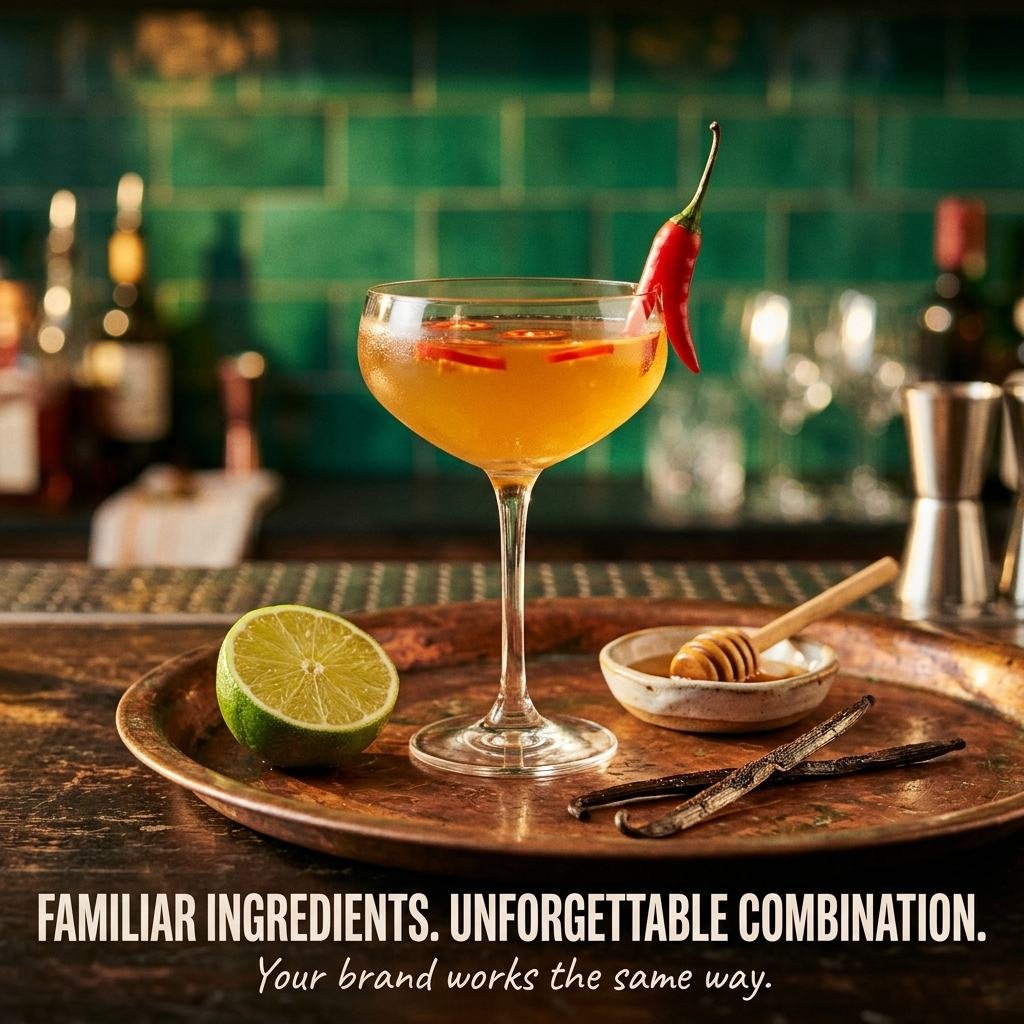
Every single ingredient is something you've tasted before. Vanilla, honey, lime, chili. Nothing exotic. But in this combination, they become something you weren't expecting and won't forget.
Your brand works the same way. The ingredients of what makes a brand unique are things you already have: your experience, your opinions, your voice, your specific way of seeing your industry. You don't need to invent new ingredients. You need to stop arranging them the same way everyone else does.
A bookkeeper who opens every blog post with a dry observation about her clients' receipt drawers is already more memorable than one whose homepage says "accurate, reliable, detail-oriented." A photographer who tells you exactly which lighting setups she refuses to use (and why) is more interesting than one who promises "timeless, beautiful images."
The specificity is the personality. And the personality is the brand uniqueness.
What Happens When You Let Your Brand Uniqueness Show
The business case for brand uniqueness isn't theoretical. Consistent brand presentation increases revenue by 23–33%. But here's the part most people miss: consistency means sounding like yourself everywhere. If there's nothing distinctive to be consistent with, repetition just compounds the generic.
More than 70% of consumers spend more with brands they perceive as authentic. Authentic, in this context, means specific. It means the reader can tell a human being wrote it. It means your brand sounds like someone's voice, not a template.
When brand uniqueness is working:
🔶 Someone can identify your content before they see your name on it
🔶 Your writing sounds like a conversation you'd actually have, not a LinkedIn post you think you should write
🔶 Your offers feel connected to a personality, not just a service list
🔶 People describe you using specific language, not category labels
The "Almost Too Much" Test
If you want a quick way to check your own brand uniqueness, try this.
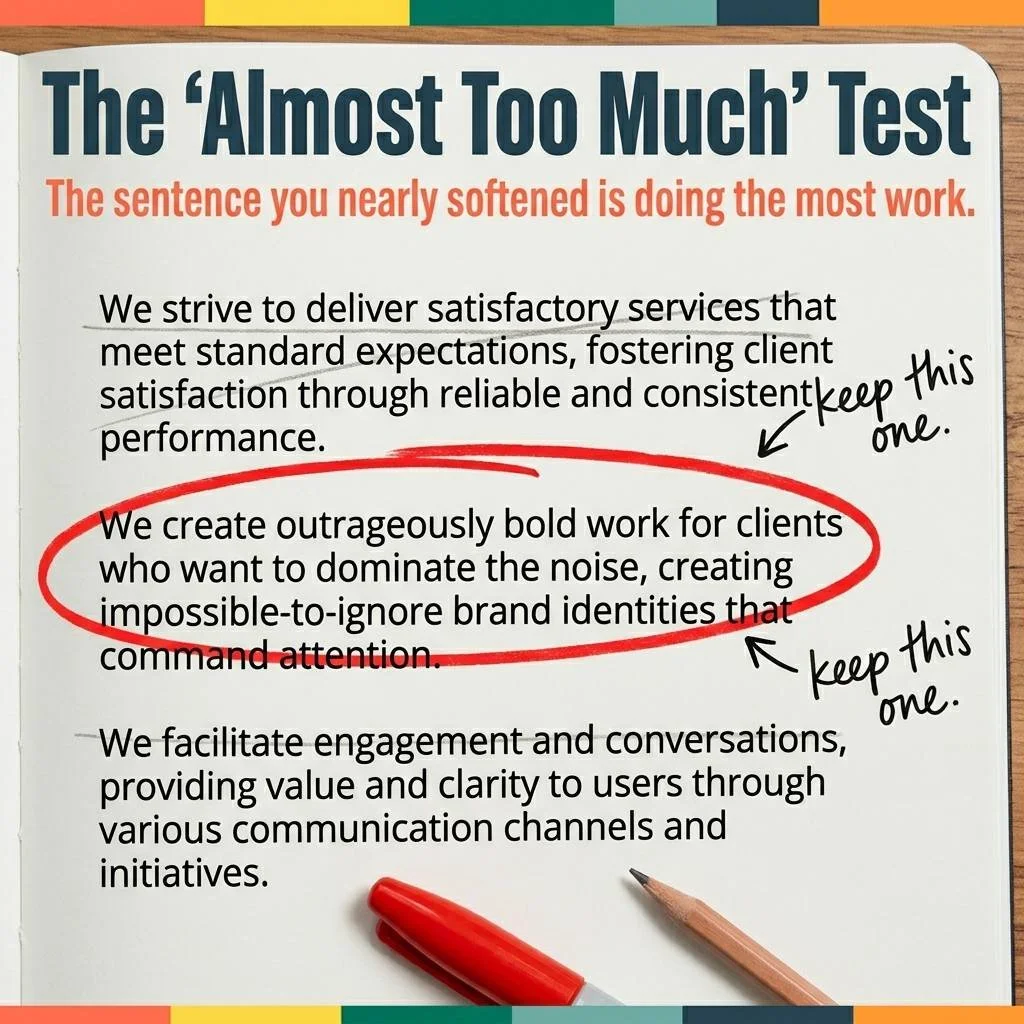
Look at the last few things you've written for your business. Find the sentence you almost softened before posting. The one that felt a little too direct, a little too specific, a little too you. That sentence is almost always doing the most personality work of anything on the page.
The instinct to soften it is the polish problem at work. Your brain has been trained to smooth things out, to sound professional, to stay in the lane your industry carved for you. But the stuff that makes someone stop scrolling and think, "Oh, I like her," is the stuff that lives outside that lane.
A few places to check:
🔶 Your bio. Does the second half get more professional and less interesting than the first half? That's where the personality dims.
🔶 Your offer descriptions. Could a competitor use the same "Best For" line without changing a word? If so, there's no fingerprint.
🔶 Your captions. Is the strongest line buried at the bottom? Let it lead.
🔶 Your transitions. Phrases like "intentional, distinctive, and built to work" or "clarity, structure, and strategy" are connective tissue that could live on any website. One swap can change the temperature of an entire page.
If you're finding polish in more spots than you expected, that's a sign your brand has grown faster than your voice has kept up. And that's exactly what regular brand check-ins are for.
Brand Uniqueness Compounds Over Time
Brand uniqueness isn't a one-time project. It's something you maintain, check in on, and protect, especially as your business evolves and the professional instincts get stronger.
The business owners I work with inside The Brand Bar get a monthly Brand Recipe focused on exactly this kind of refinement. This month, we're looking at where personality is landing and where the polish is creeping in. The moves are small and specific: find one consultant-y phrase on your homepage and rewrite it the way you'd actually say it on a Voxer message. Let the strongest line in your caption lead instead of burying it at the bottom. Add one parenthetical aside to an offer description that sounds like you on your best day, not your most polished one.
Because the goal was never to have a "nice" brand. It was to have a brand that sounds like no one else. And that brand already exists inside you. You just have to stop cleaning it up.
Your brand is already unique. The work is letting it show. If you're ready to find the personality that's been polished out and put it back where it belongs, The Brand Bar is where signature brands stay sharp.
Keep Reading
🔸 Why Your Brand Sounds Boring When You Actually Love This Work: Your writing can be perfectly fine and still sound boring, and this post explains why.
🔸 Brand Chemistry: Why the Right Clients Just "Get" You: Uniqueness is what draws the right clients in, and this post is about the chemistry that follows.
🔸 What Makes a Brand Work: The 3 Pillars Every Signature Brand Is Built On: Personality is one of the pillars, and this post shows how it works with credibility and expression.